|
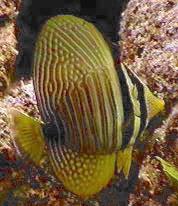
LivestockFish- Sailfin Tang, Zebrasoma desjardinii
- This is the large fish which is yellow, white, brown, and grey, with stripes and spots in these colors. I obtained it in May, 1993 as a juvenile about 1.25 inches long. It is now over 2 inches and healthy. It is primarily an algae eater, prefering hair algae and other soft fiberous algaes, although it will also eat prepared foods. It is an active swimmer and not at all afraid of me.
- Royal Gramma, Gramma loreto
- This is the smaller half purple, half yellow fish. I obtained it in June, 1994 when it was about 1.5 inches. It is an opportunistic feeder of whatever happens to be floating in the water. I feed it alternately brine shrimp and formula 1, approximately every other day. It likes to build a nest out of algae, though it also spends part of its time in the open water.
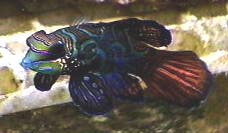
- Mandarin Fish, Synchiropus splendidus
- This fish was added on 12-Nov-94. It's a decent sized male and appears healthy.
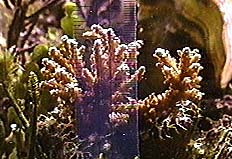
Stony Corals- Acropora microphthalma
- The parent colony is in an outdoor tank maintained by Bruce Carlson at the Waikiki Aquarium. This colony was originally collected from Fiji in 1990 on a fore-reef slope off Pacific Harbour at a depth of about 45 feet. It was part of a huge mono-clonal colony about 30 feet across. I received this fragment in October, 1994 as part of the Acropora Challenge.
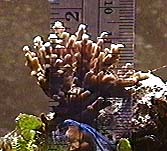
- Acropora elseyi
- This coral glows green under actinic lights. The parent colony (pictured on page 66 of The Reef Aquarium by Charles Delbeek and Julian Sprung) is in an outdoor tank maintained by Bruce Carlson at the Waikiki Aquarium. This colony was originally collected from Fiji in 1990 on a reef flat off Suva at a depth of about 5 feet. I received this fragment in October, 1994 as part of the Acropora Challenge.
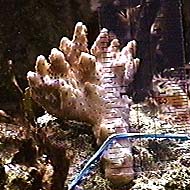
- Leaf coral, Pavona cactus
- The parent colony is from Palau, collected in 1988. I received this fragment in October, 1994 as part of the Acropora Challenge.
- Finger coral, Montipora digitata
- The parent colony is from Palau, collected in 1988, literally from Gerry Heslinga's backyard at a depth of 3 feet. I received this fragment in October, 1994 as part of the Acropora Challenge.
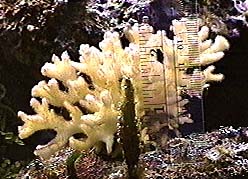
- Bird's nest coral, Pocillopora damicornis
- I got a good price on this at a local pet store because it was bleaching nearly white. This was the first "Acropora" (as the pet store labelled it) I had actually seen. It has very slowly regained some color, though it is still very pale. The polyps open and I think it has grown a little. I got this colony in August, 1994.
- Open brain coral, Lobophyllia hataii
- This colony was almost pure white when I bought it in August, 1993. It is now a pale cream color, with greenish bands along the outside. It puffs up during the day, and puts out feeding tentacles at night or when I put food in the tank.
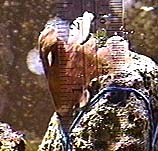
- Elegance coral, Catalaphyllia jardinei
- This colony has a skeleton about 2.5 inches across, but opens 8 to 10 inches during the day, and about half that at night. I purchased it in July, 1993.
- Torch coral, Euphyllia divisa
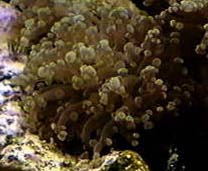
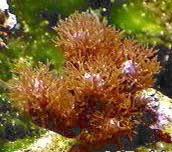
- Also called a frogspawn coral because of the appearance of the tentacles, this one has a branching skeleton. It was purchased in November, 1993, and has added perhaps 1/2 inch of skeleton in a year.
Soft Corals- Yellow polyps, Parazoanthus axinellae
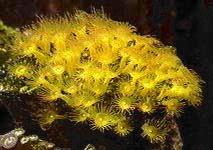
- These polyps all came into the aquarium on one rock in September, 1993. They now appear in four different places in the aquarium.
- Button polyps, Zoanthus sp.
- Most of these polyps came in on one rock in August, 1993. This was unusual in that there were 3 different color patterns in the polyps on this rock (bright green centers, yellowish centers, and mottled white/grey centers). These have spread to several other nearby rocks. There are also a few solitary polyps that were added from another colony. One of these has since grown a colony of 9 polyps.
- Mushroom corals, Actinodiscus sp.
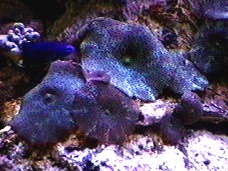
- Three solitary polyps (one blue, two greenish) were added from a friend's tank in September, 1993. The original blue one disappeared into the rocks, though it left behind three children. One of the green ones has only divided once, the other has divided six times.
- Anthelia sp.
- Just a few polyps were recieved in September, 1993 from a friend's tank. This has grown to a patch of a dozen polyps, with a second patch appearing about a year later.
- Gorgonia sp.
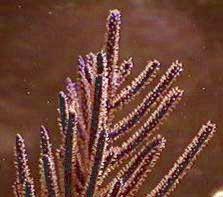
- This specimen was purchased in November, 1993. A few of the branches have died back, but the tops have definately grown. It regularly gets some slime algae growing on it, then slimes that away and will open for a few days, then become overgrown again. I try to squirt it with a turkey baster to keep it clear when I notice it becoming overgrown.
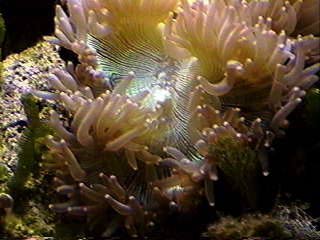
- Encrusting Gorgonian, Cladiella sp.
- This specimen just grew out of the live rock. It appeared as two waving tentacles on a dime sized smudge of tissue in January, 1991. It now has 8 fingers each a couple of inches long, and has proved very hardy.
- ? Cladiella sp?
- This grew out of the live rock. I first noticed it in March 1993 when it was just a couple polyps in a spot on the rock. In a year it grew about 2 inches.
Other Inverts- Giant clam, Tridacna maxima
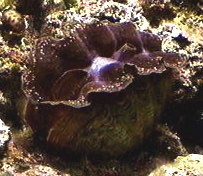
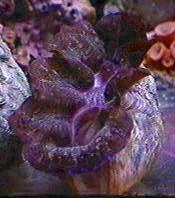
- This clam was purchased in May, 1993. It was originally a greyish purple with blue spots along the edges of its mantle. It has darkened to a deep purple/brown, and the spots are gold now. It has only put on about 1/4 inch of new shell, though that includes two sets of "scutes".
- Giant clam, Tridacna derasa
- This clam was purchased in March, 1992 and initially put in another aquarium. It was moved to this tank in October, 1993. It has put on over an inch of new shell.
- Giant clam, Tridacna crocea
- This clam was purchased in October, 1994. It has a mottled blue and tan mantle.
- Coral banded shrimp, Stenopus hispidus
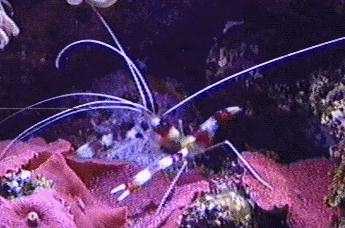
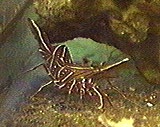
- This is the surviving shrimp from a pair added in June, 1993. It killed the other shrimp. I had thought they would make a pair because they had co-existed in a dealer's tank for several weeks before I got them. They stayed together in my tank for about 6 weeks. The shrimp likes to molt down under the rocks, so I only rarely see a discarded skin to know how often he is molting.
- Peppermint shrimp, Rhynchocinetes_uritai
- I added three of these in April, 1994. I believe that only two survive now, though it is difficult to tell. I can regularly see bits of them between the rocks, though they seldom come out into the open, and I rarely see more than one at a time.
- Astrea snails, Astrea tecta
- I started the tank in Feb. 1993 with 9 of these, of which I believe 6 are still surviving. They have all at least doubled in size. In October 1994 I added 10 more snails. A baby appeared on the glass in September, 1994. While it may have been from a spawn, I suspect that it came in as a hitchhiker on a coral or other addition to the tank.
- Siphonaria
- Four of these small limpets were added at the same time as the Acropora Challenge II fragments. I haven't seen them since, and suspect that they did not survive.
Live RockThis tank contains 110 pounds of live rock, with lots of life on it. This is about 80 pounds of "plant rock" from one Florida supplier, and about 30 pounds of "reef rock" from another Florida supplier.On the rock, I have seen orange and yellow encrusting sponges, tunicates, three varieties of urchins (removed from the tank), many brittle stars, three small crabs (two of them were removed; I have been unable to capture the third, which is now sizable and red. However I have only seen it eat brown algae, and think it is OK), one mantis shrimp (captured and killed), some bristle worms, three tiny patches of stoney coral, many fanworms, a couple rock-boring oysters, several kinds of macro algae, and more. |







No comments:
Post a Comment